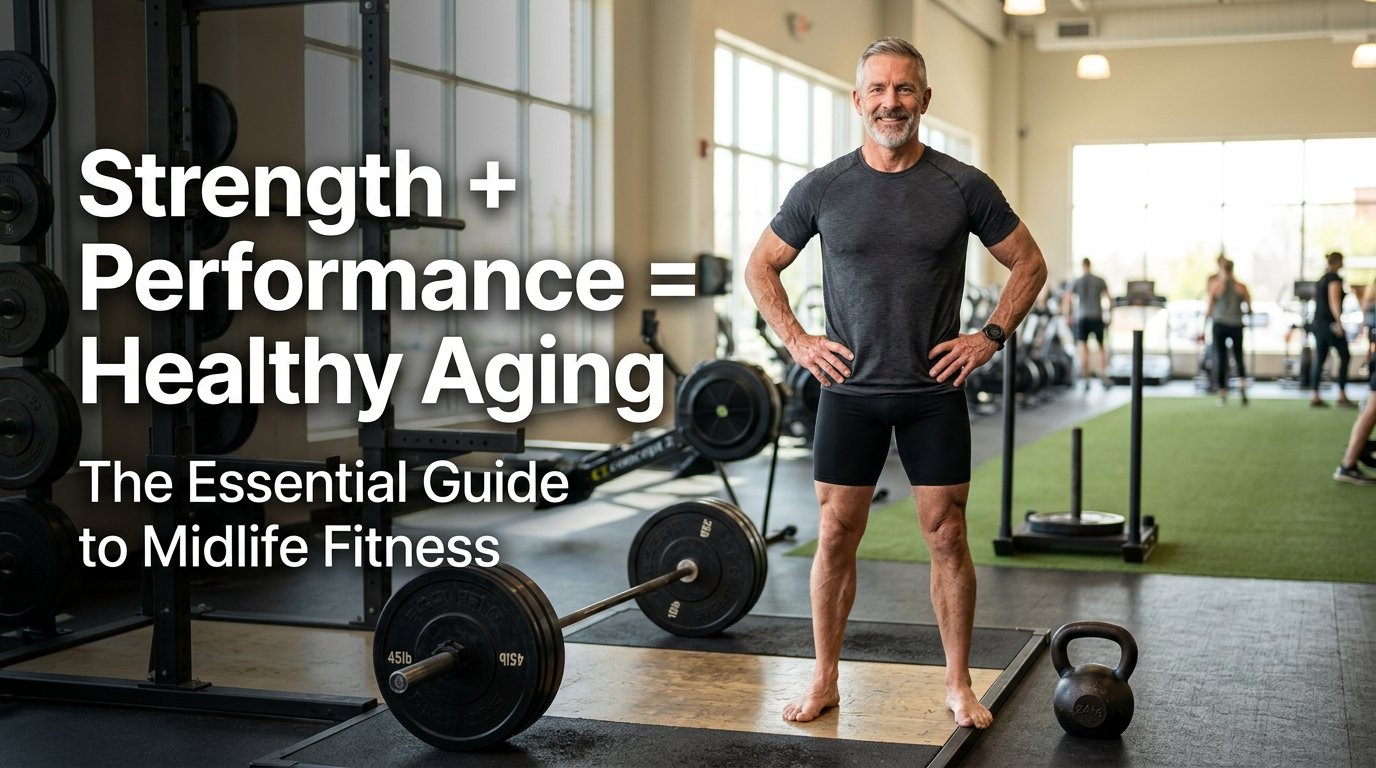
The debate around strength training vs performance fitness for older adult athletes hit me hard the year I turned 52. I’d been squatting heavy for a decade, feeling bulletproof, and then a weekend hiking trip with my 30-year-old nephew left me gasping at mile three. Strong? Absolutely. Fit for real life? Not even close. That wake-up call sent me down a rabbit hole that completely changed how I train. If you’re an older athlete stuck choosing between raw strength and functional performance, this one’s for you.

What We Actually Mean by Strength Training
Strength training, at its core, is about progressive overload. You pick up heavy things, put them down, and gradually increase the load. Think barbell squats, deadlifts, bench press, and heavy rows. The goal is simple: make muscles stronger and build or maintain lean mass.
For older athletes, this matters more than most people realize. After age 40, we lose roughly 8% of our muscle mass per decade, and that rate accelerates after 70. Resistance training is the single most effective tool we have to fight sarcopenia, which is just the fancy medical term for age-related muscle loss. I’ve seen 65-year-old powerlifters who move better than sedentary 35-year-olds, and it’s not genetic luck. It’s consistent barbell work.
But here’s what nobody tells you at the squat rack: being strong in a fixed plane of motion doesn’t automatically mean your body can perform when life throws you a curveball. Catching yourself on ice, sprinting after a grandkid, hauling luggage through an airport, those demand something beyond a 300-pound deadlift.
What Performance Fitness Actually Looks Like
Performance fitness is harder to pin down because it covers a broader range of physical qualities. We’re talking about power output, cardiovascular endurance, agility, balance, coordination, and the ability to move well across multiple planes of motion. Programs like CrossFit, tactical fitness protocols, and sport-specific training all fall under this umbrella.
A performance-focused session might include box jumps, kettlebell swings, rowing intervals, lateral shuffles, and loaded carries, all in the same workout. The emphasis shifts from “how much can you lift?” to “how well can your body handle varied physical demands?”
I started incorporating performance work about three years ago after that humbling hike. The first thing I noticed was how terrible my conditioning had become despite years of heavy lifting. My heart rate skyrocketed during a simple circuit of kettlebell swings and burpees. My mobility was embarrassing. I could squat 365 pounds but couldn’t touch my toes without bending my knees.
That contrast, strong but not truly fit, is way more common among older lifters than anyone wants to admit.
Strength Training vs Performance Fitness for Older Adult Athletes: The Real Differences
Let me break this down honestly, because the internet loves to make everything black and white when the truth lives in the gray.
Strength training prioritizes maximal force production. You get stronger. Your bones get denser. Your joints, when loaded properly, get more resilient. Recovery between sets is long, and the metabolic demand during a session is relatively low. You won’t be breathing hard after a set of five heavy deadlifts, at least not the way you breathe hard during a 400-meter sprint.
Performance fitness prioritizes adaptability. You build work capacity, cardiovascular health, reactive balance, and the kind of coordination that keeps you athletic rather than just muscular. The downside? Pure strength gains come slower because you’re spreading your training energy across more physical qualities.
For older athletes specifically, the risks differ too. Heavy strength training puts significant load on connective tissue that recovers slower after 50. Performance training introduces impact, speed, and fatigue, all of which increase injury risk if your movement quality isn’t solid.
Neither approach is automatically better. The right answer depends entirely on what your body needs most right now.
Why Pure Strength Training Falls Short After 50
I’ll be the first to defend heavy lifting. It saved my back, my confidence, and probably my long-term health. But around age 53, I started noticing gaps that no amount of squatting could fill.
My resting heart rate was creeping up. Playing pickup basketball left me sore in strange places because my body had forgotten how to move laterally. I got winded carrying groceries up three flights of stairs, which felt absurd for someone who could rep 225 on bench without blinking.
The research backs this up. A 2022 study published in the British Journal of Sports Medicine found that older adults who combined resistance training with cardiovascular and balance work had significantly better functional outcomes than those who only lifted weights. Stronger, sure, but also more capable in daily life.
Pure strength work also tends to neglect the fast-twitch muscle fibers responsible for power, the explosive quality you need to catch yourself during a fall. After 60, power declines even faster than strength, and traditional slow, grinding lifts don’t train that quality effectively.
Why Performance-Only Training Has Its Own Problems
Flip side. I’ve watched friends my age jump headfirst into high-intensity performance programs and get absolutely wrecked within months.
One buddy joined a CrossFit box at 55 with zero strength base. Six weeks in, he tore his rotator cuff during kipping pull-ups. Another friend started a HIIT-heavy program and developed knee tendinitis because her legs simply weren’t strong enough to handle the repeated jumping and landing forces.
Performance fitness without a strength foundation is like building a house on sand. Your muscles need baseline strength to absorb impact, stabilize joints under fatigue, and recover between intense efforts. Skipping that foundation is how older athletes end up injured, frustrated, and back on the couch.
There’s also the recovery issue. High-intensity training creates more systemic fatigue than heavy lifting in many cases. When you’re 30, you bounce back from a brutal conditioning session in 24 hours. At 55, that same session might leave you dragging for three days. IMO, most performance programs marketed to general populations don’t account for how dramatically recovery needs change with age.
The Hybrid Approach That Actually Works
After three years of experimenting on myself, reading every study I could find, and talking to coaches who specialize in masters athletes, I landed on a hybrid model that’s kept me feeling better at 55 than I did at 50.
Here’s the basic framework I follow:
- Three days of strength work focused on compound lifts with moderate to heavy loads
- Two days of performance work mixing kettlebell complexes, rowing intervals, and agility drills
- Daily mobility work, even if it’s just 10 minutes of hip openers and thoracic spine rotations
The strength days protect my muscle mass, bone density, and joint integrity. The performance days keep my heart strong, my movement quality sharp, and my body capable of doing things outside the gym. The mobility work is the glue holding everything together.
I keep my heavy sets in the 3 to 5 rep range and never chase one-rep maxes anymore. On performance days, I monitor my heart rate and scale intensity based on how recovered I feel. Some weeks, that means hard rowing sprints. Other weeks, it means light kettlebell flows and long walks.
This isn’t glamorous programming. Nobody’s filming this for Instagram. But it works, and it’s sustainable, which is the only metric that matters when you’re training for the next 30 years of your life.
How to Know Which Side Needs More Attention
Not everyone needs a perfect 50/50 split between strength and performance work. The ratio should reflect your current weaknesses, not your preferences.
If you can deadlift double your bodyweight but get winded walking up a hill, you need more conditioning. If you can run a 5K but struggle to carry heavy bags or get off the floor without using your hands, you need more strength.
A simple self-assessment I use every few months: Can I carry two heavy grocery bags up two flights of stairs without stopping? Can I get off the floor without touching a hand or knee down? Can I sprint 50 yards without feeling like my hamstrings are going to snap? Can I hold a single-leg stance for 30 seconds with my eyes closed?
If any of those feel shaky, that’s where my training emphasis shifts for the next training block. FYI, the eyes-closed balance test is humbling for almost everyone over 50. Try it before you brag about your squat numbers.
Recovery Is the Part Nobody Wants to Talk About
Here’s where strength training vs performance fitness for older adult athletes gets really personal. Recovery isn’t just about foam rolling and protein shakes. It’s about sleep quality, stress management, nutrition timing, and honestly admitting when your body needs a day off.
I track my heart rate variability using a Whoop band. When my HRV drops, I scale back. When it’s high, I push harder. This single habit has prevented more injuries than any warm-up routine ever did.
Older athletes also need more protein than younger ones. The current research suggests 1.2 to 1.6 grams per kilogram of bodyweight for active adults over 50. I aim for the higher end and notice a real difference in how fast I recover between sessions.
Sleep is non-negotiable. Seven hours minimum. I know that sounds obvious, but I spent years surviving on six hours and wondering why my shoulders always hurt. Turns out chronic sleep deprivation increases systemic inflammation, which makes every joint in your body angrier. Who knew? Well, the scientists knew. I just wasn’t listening.
Programming Tips for Older Athletes Who Want Both
If you’re ready to blend strength and performance work, a few practical tips from someone who’s made every mistake in the book:
Start with three strength sessions per week for at least 12 weeks before adding performance work. Build that base first. Your tendons and ligaments need time to adapt, and they remodel slower than muscle tissue.
When you add conditioning, start with low-impact options. Rowing machines, battle ropes, and loaded carries are much friendlier to aging joints than box jumps and sprints. Graduate to higher-impact work only after your body proves it can handle the basics without flaring up.
Never schedule heavy squats and hard conditioning on back-to-back days. Your lower back and knees will thank you. I separate them by at least 48 hours.
Work with a coach or experienced training partner if possible. Ego is the number one injury risk for older athletes. Having someone who tells you “that’s enough for today” is worth more than any supplement or recovery gadget on the market.
Frequently Asked Questions
Is strength training or performance fitness safer for adults over 60?
Neither is inherently safer. Safety depends on programming, load management, and movement quality. Strength training with proper form and gradual progression is very safe. Performance work becomes risky only when intensity exceeds your current fitness base. Start conservatively with either approach and build gradually. A good coach makes both options safe for any age.
Can older athletes build muscle while doing performance-based training?
Yes, but it’s slower compared to dedicated strength programs. Performance training builds some muscle, especially in beginners, but the varied stimulus doesn’t optimize hypertrophy the way focused resistance training does. If muscle gain is your primary goal, prioritize strength work and add performance sessions as a secondary focus two days per week.
How many days per week should an older athlete train?
Four to five days works well for most older athletes when you mix intensities. Three strength-focused days and one to two lighter performance or conditioning days is a solid starting framework. Always include at least two full rest days per week. Recovery capacity decreases with age, and more training isn’t always better training.
What’s the biggest mistake older athletes make when choosing between these approaches?
Going all-in on one while completely ignoring the other. I see lifters who haven’t done any cardio in years and runners who haven’t touched a weight in decades. Both end up with significant physical gaps that increase injury risk and reduce quality of life. A balanced approach always wins long-term, even if the split isn’t perfectly even.
Should older adult athletes avoid high-intensity interval training?
Not necessarily, but they should earn the right to do it. Build a cardiovascular base with moderate-intensity work first, then introduce short HIIT sessions gradually. Monitor recovery closely. If you’re still sore or fatigued 48 hours after a HIIT session, the intensity was too high. Scale back and build up over weeks, not days.
Conclusion
Choosing between strength and performance fitness isn’t really a choice at all when you’re training past 50. You need both, just in the right proportions for where your body is right now. The best program is the one that keeps you strong, capable, and injury-free for decades, not just the next PR. What does your current training split look like, and where are the gaps?