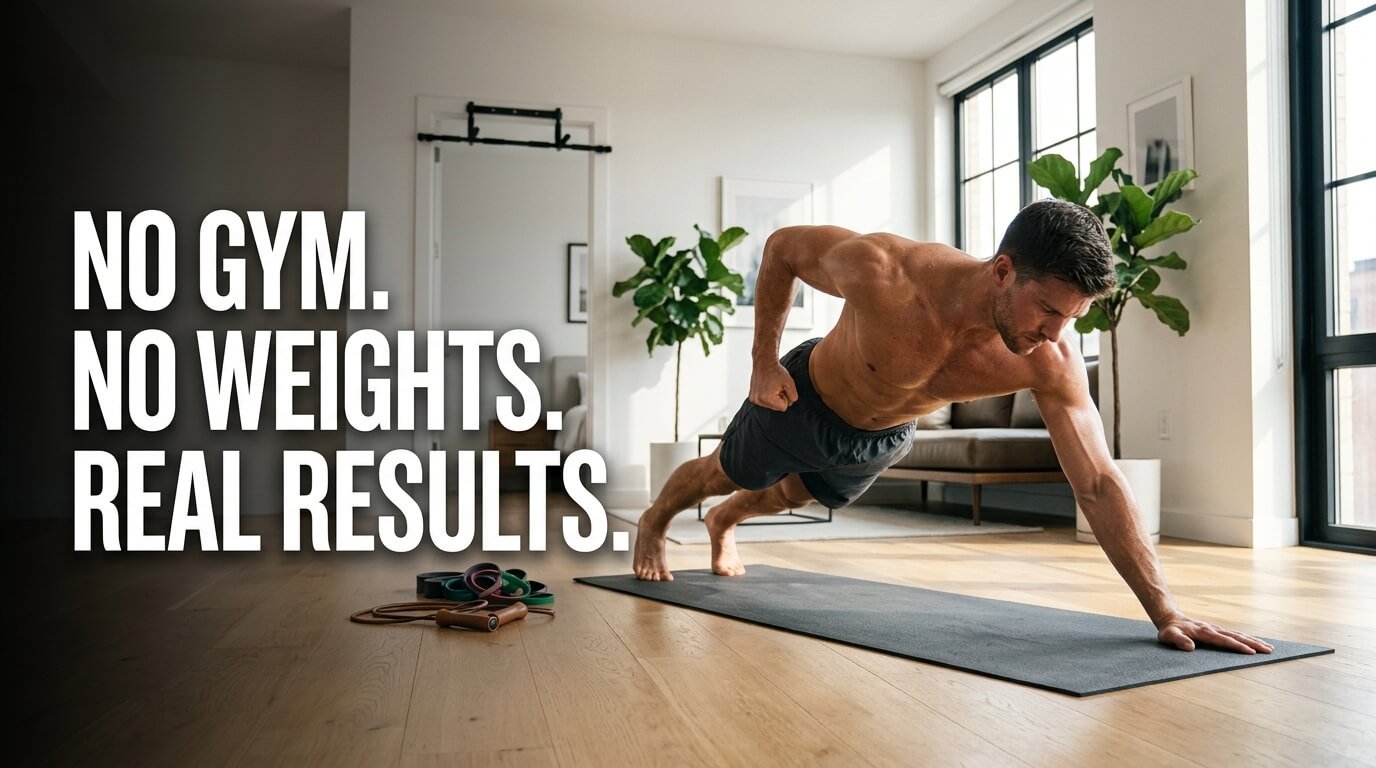
I spent years convinced that building real athletic strength required a gym membership and a rack of dumbbells. Then my local gym closed, I moved into a tiny apartment, and I discovered that performance fitness routines without heavy weights or machines can actually deliver better results than anything I’d done before. The freedom hit different. No commute, no waiting for equipment, no excuses.
Why Performance Fitness Routines Without Heavy Weights Work
Your body doesn’t care where resistance comes from. It only knows tension, time under load, and progressive challenge. Bodyweight training and minimal equipment work because they force multiple muscle groups to coordinate together, exactly like they do in real life.
Think about it. When you sprint, jump, or climb, your muscles don’t isolate. They fire in chains. Machine-based training often breaks those natural patterns. Equipment-free routines restore them.
Research from the Journal of Strength and Conditioning backs this up. Participants using bodyweight protocols showed comparable strength gains to those using traditional resistance training, with better improvements in functional movement patterns. The difference matters for anyone who wants fitness that actually transfers to daily life, sports, or outdoor adventures.
Assessing Your Starting Point
Before you build any routine, you need an honest baseline. Not an ego-driven one where you pretend you can do more than you actually can.
Test these five movements and write down your numbers: max push-ups in one set, max bodyweight squats in 60 seconds, max pull-ups (or how long you can hold a dead hang if you can’t do one yet), a plank hold for time, and how long you can balance on one leg with eyes closed. These cover pushing, pulling, lower body power, core stability, and proprioception.
Don’t skip the balance test. It reveals weaknesses that predict injury risk. I ignored mine for months and ended up with a tweaked ankle that set me back weeks. Save yourself the trouble.
Building Your Foundation Phase
The first four weeks focus on movement quality over intensity. This isn’t about being soft. It’s about building patterns that let you train hard later without breaking down.
Start every session with joint circles. Wrists, elbows, shoulders, hips, knees, ankles. Two minutes, minimum. Then add crawling patterns. Bear crawls forward and backward, crab walks, army crawls. These feel silly until you realize they’re building shoulder stability, hip mobility, and core coordination simultaneously.
Your foundation workouts should include slow, controlled versions of basic movements. Squats with a three-second descent, push-ups with a pause at the bottom, lunges where you actually feel your glutes working. Volume stays moderate. Three sets of 8-12 reps per movement, three days per week. The goal is consistent exposure without soreness that limits your next session.
Programming Progressive Overload Without Adding Weight
Here’s where most people get stuck. They assume bodyweight means endless repetitions of the same exercise forever. That’s a recipe for plateaus and boredom.
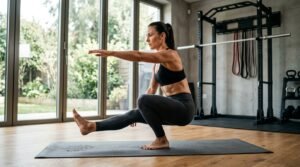
Progressive overload without equipment comes from several variables. Leverage changes work incredibly well. A standard push-up becomes harder as you elevate your feet, then shift to archer push-ups, then one-arm progressions. A bodyweight squat becomes a pistol squat through intermediate steps like assisted versions and box pistols.
Tempo manipulation adds intensity without changing the exercise at all. A 5-second eccentric (lowering phase) on any movement creates muscle tension that rivals heavy weights. Pause holds at the hardest point of each rep do the same thing.
Density training changes how much work you do in a fixed time. If you completed 50 push-ups in 10 minutes last week, aim for 55 this week. Same time, more work, guaranteed progress.
Upper Body Performance Routines
Training your upper body without machines requires creativity and consistency. Pull-ups remain the gold standard for back development, and if you can’t do one yet, you’re not alone. Invest $25 in a doorway pull-up bar and start with dead hangs, then negatives (jumping up and lowering slowly), then assisted versions with a foot on a chair.
For pushing, graduate beyond basic push-ups quickly. Diamond push-ups hammer your triceps. Pike push-ups shift emphasis to shoulders. Pseudo planche push-ups, where you lean forward with hands near your hips, build serious anterior shoulder strength.
Dips using two sturdy chairs or a kitchen counter give you another pushing angle. Keep your shoulders packed down and back. The moment they roll forward, you’re asking for trouble.
A solid upper body day looks like this: 4 sets of your hardest pull-up variation, 4 sets of your hardest push-up variation, 3 sets of dips, 3 sets of inverted rows using a table edge or low bar. Rest 90 seconds between sets. The whole thing takes 35 minutes.
Lower Body Power Development
Your legs can handle serious load. Building them without barbells means emphasizing single-leg work, explosive movements, and isometric holds.
Single-leg exercises create natural overload because you’re lifting your entire bodyweight through one limb. Bulgarian split squats using a couch or chair for your back foot will humble anyone. Start with bodyweight, then add tempo variations once 12 reps feel manageable.
Explosive work comes from jump training. Box jumps, broad jumps, tuck jumps, and single-leg bounds all build power that transfers directly to athletic performance. Start with low volume, maybe 20-30 total jumps per session, because the eccentric stress on landing adds up fast.
Wall sits and deep squat holds build time-under-tension that creates stability and muscular endurance. Hold a deep squat position for cumulative time, aiming for 3-5 minutes total across multiple sets. Your quads will burn. That’s the point.
Nordic curls, done with your feet anchored under a couch and your body lowering forward, might be the single best hamstring exercise available without equipment. They’re brutal. Start with just the negative portion and use your hands to push back up.
Core Training That Actually Transfers
Forget endless crunches. Performance-focused core work trains stability, rotation resistance, and force transfer between your upper and lower body.
Dead bugs and bird dogs build anti-extension strength. Paloff holds (using a resistance band anchored to a door) build anti-rotation. Side planks build lateral stability. These three categories cover everything your core actually needs to do.
Hollow body holds, borrowed from gymnastics, teach total-body tension better than any other exercise I’ve found. Lie on your back, press your lower back into the floor, extend your arms overhead and legs out straight, then hold that position while maintaining the back contact. Twenty seconds will feel like forever at first.
Add loaded carries once you have access to anything heavy, groceries, a backpack filled with books, a sandbag. Walk for distance while keeping your posture perfect. This single exercise builds core strength, grip strength, and mental toughness simultaneously.
Conditioning Without Cardio Machines
Treadmills and ellipticals bore me to tears. Performance-oriented conditioning uses intervals, circuits, and movement complexes instead.
Sprint intervals on flat ground or hills deliver cardiovascular benefits that steady-state cardio can’t match. Find a 40-50 yard stretch and sprint hard, walk back, repeat for 10-15 rounds. The entire session takes 15 minutes and leaves you gasping.
Circuit training combines strength movements back-to-back with minimal rest. A simple example: 10 push-ups, 10 squats, 10 mountain climbers, 10 lunges (each leg). Complete 5 rounds as fast as possible with good form. Track your time and beat it next week.
Jump rope remains underrated. Ten minutes of varied jump rope intervals, alternating between single-unders, high knees, and double-unders if you can manage them, creates conditioning that transfers to almost any sport. A decent speed rope costs under $15.
Recovery and Mobility Integration
Training hard without recovering smart leads to burnout, injury, or both. Schedule at least two full recovery days per week where you move gently but don’t push intensity.
Mobility work should target your personal tight spots. Most desk workers need hip flexor stretches, thoracic spine rotation, and shoulder external rotation drills. Spend 10-15 minutes daily on these areas, either as a morning routine or evening wind-down.
Sleep matters more than any supplement or recovery tool. Seven to nine hours, consistently, in a cool dark room. I know it sounds obvious, but I ignored this advice for years and wondered why my progress stalled. Fixed my sleep, fixed my recovery, started making gains again.
Foam rolling and soft tissue work help, but don’t overdo it. Five minutes before training to prime specific areas works better than 30-minute rolling sessions that leave you too relaxed to perform.
Sample Weekly Training Schedule
Here’s a realistic schedule for building performance fitness routines without heavy weights or machines into a sustainable practice:
Monday: Upper body strength focus
Tuesday: Lower body and explosive power
Wednesday: Active recovery, mobility work, and light movement
Thursday: Full body circuit conditioning
Friday: Upper body volume with different variations
Saturday: Lower body strength plus core emphasis
Sunday: Complete rest or gentle outdoor activity
This structure provides enough stimulus for progress without overwhelming your recovery capacity. Adjust based on your life, sleep quality, and stress levels. Some weeks you’ll need an extra rest day. Take it.
Frequently Asked Questions
Can You Build Serious Muscle Without Weights?
Absolutely. Muscle growth requires progressive tension, adequate protein intake, and recovery time. Bodyweight progressions provide plenty of tension when you choose challenging variations and manipulate tempo. I’ve added noticeable muscle to my shoulders and back using only pull-up and push-up variations. The key is progressing to harder movements as you get stronger.
How Long Before You See Results From Equipment-Free Training?
Most people notice improved movement quality within two weeks. Visible changes typically appear around the six-week mark if you’re consistent and eating enough protein. Strength gains often surprise people, they’ll suddenly nail a movement that felt impossible before. Track your baseline tests monthly and you’ll see objective progress.
Is Bodyweight Training Enough for Athletic Performance?
For most recreational athletes, yes. Sprinters, martial artists, gymnasts, and rock climbers all build incredible performance with minimal equipment. If you’re competing at elite levels in powerlifting or bodybuilding, you’ll eventually need external load. For general athleticism, performance fitness routines without machines or weights deliver excellent results.
How Do You Progress When Bodyweight Exercises Get Easy?
Move to harder variations. Add tempo challenges. Increase volume or density. Combine movements into complexes. A basic push-up progression goes: incline push-ups, standard, decline, diamond, archer, one-arm negatives, one-arm push-ups. Most people never exhaust these progressions. There’s always a harder version waiting.
What Minimal Equipment Is Worth Buying?
A doorway pull-up bar ranks first for upper body development. A set of resistance bands adds variety and accommodating resistance. A jump rope improves conditioning cheaply. Parallettes or push-up handles enable deeper ranges of motion. You can build a complete home setup for under $100 that lasts years.
Conclusion
The gym isn’t the gatekeeper of fitness that the industry wants you to believe it is. Your body, some floor space, and a willingness to progress through challenging movements will take you further than most people expect. What’s the first movement you’re planning to master?