Performance fitness plans for people who have chronic knee pain sound like a contradiction, right? I thought so too, standing in my gym three years ago with swollen knees and a doctor telling me to “just take it easy.” But taking it easy felt like giving up. I refused. Instead, I spent years testing, failing, adjusting, and finally building training routines that let me stay strong and fast without destroying my joints. If your knees scream at you but your ambition won’t shut up, this one’s for you.
Why Traditional Fitness Plans Fail Chronic Knee Pain Sufferers
Most programs assume healthy joints. They throw in barbell back squats, box jumps, and deep lunges on day one without a second thought. For someone with osteoarthritis, patellar tendinopathy, or cartilage issues, that’s a fast track to a flare-up.
I learned this the hard way when I followed a popular strength program and couldn’t walk down stairs for a week. The problem wasn’t effort. It was programming. Traditional plans load the knee joint in positions and volumes it simply can’t tolerate repeatedly. High-impact plyometrics, deep flexion under heavy loads, and high-rep leg extensions all pile stress onto an already compromised joint.
A good performance fitness plan for people who have chronic knee pain doesn’t just swap exercises randomly. It rethinks loading angles, volume distribution, and recovery timelines around what your knees can actually handle while still pushing your performance forward.
Step 1: Get a Clear Picture of Your Specific Knee Issue
Not all knee pain is the same, and this matters more than most people realize. Patellar tendinitis responds differently to loading than a meniscus tear. Osteoarthritis in the medial compartment requires different movement modifications than patellofemoral syndrome.
Before you build any plan, get a proper diagnosis. I’m not talking about a five-minute urgent care visit. See a sports medicine doctor or an orthopedic specialist who works with athletes. Ask for imaging if you haven’t had it. Understanding whether your issue is structural, inflammatory, or mechanical changes everything about your programming.
I spent my first year training around pain blindly. Once I got an MRI and learned I had Grade 2 chondromalacia under my left kneecap, I finally understood why deep squats wrecked me but hip hinges felt fine. That single piece of information reshaped my entire approach.
Step 2: Build Your Foundation With Low-Impact Conditioning
Cardio matters for performance, but running and jumping might not be your friends right now. That’s okay. You have options that are honestly better than you’d expect.
Cycling became my primary conditioning tool. A stationary bike, specifically the Assault Bike or a Concept2 BikeErg, lets you push hard without the repetitive impact of running. I do interval sessions, 30 seconds all-out followed by 90 seconds easy, three times per week. My cardiovascular fitness is higher now than when I was running 5Ks.
Swimming and rowing are also excellent. The Concept2 rower is knee-friendly as long as you don’t hypercompress at the catch position. Keep your shins roughly vertical at the start of each stroke, and you’ll spare your knees while torching your legs and back.
The key is finding a modality you can hit consistently at high intensity without paying for it the next day. That’s what makes conditioning sustainable when you’re managing chronic pain.
Step 3: Restructure Your Strength Training Around Hip-Dominant Movements
Here’s where things get interesting. Most people with knee pain assume they need to skip leg day entirely. That’s the worst thing you can do. Weak legs make knee pain worse over time because the muscles surrounding the joint aren’t supporting it properly.
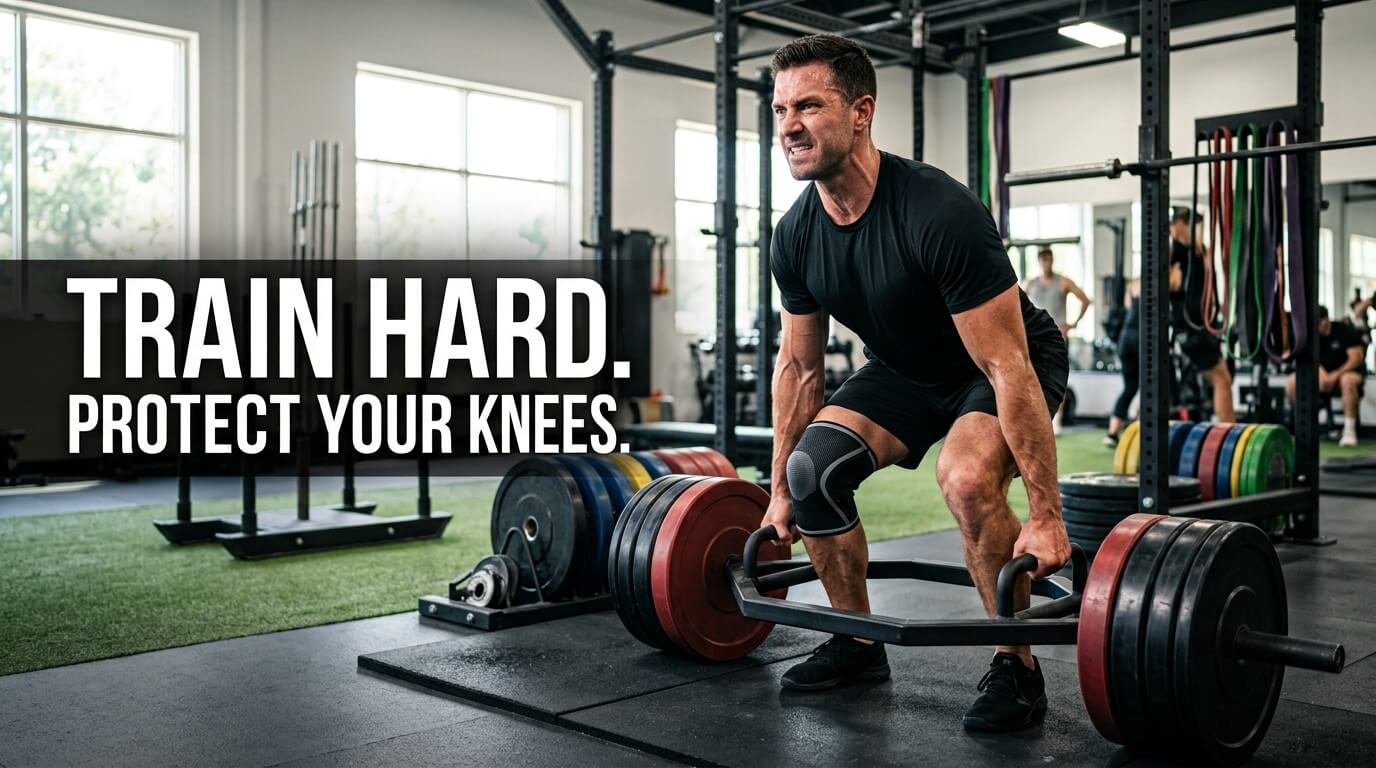
The fix is shifting your lower body work from knee-dominant patterns to hip-dominant patterns. Instead of barbell back squats, try trap bar deadlifts. Instead of walking lunges, try Romanian deadlifts or hip thrusts. These movements load your glutes, hamstrings, and posterior chain heavily while keeping knee flexion angles moderate.
My current lower body split looks like this:
- Trap bar deadlifts (heavy, 3 to 5 reps)
- Barbell hip thrusts (moderate, 8 to 12 reps)
- Single-leg Romanian deadlifts with dumbbells
- Sled pushes or drags (more on these below)
I still train my quads, but I pick exercises that don’t force deep knee bending under heavy load. Wall sits at moderate depth, terminal knee extensions with a band, and short-range leg presses with feet placed high on the platform all work well. The quad doesn’t need a full-range heavy squat to grow. It needs appropriate tension at tolerable joint angles.
Step 4: Use the Sled as Your Secret Weapon
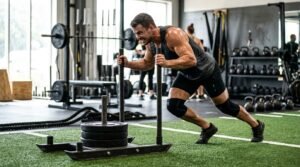
If I could only recommend one piece of equipment for anyone building performance fitness plans for people who have chronic knee pain, it would be the sled. No question.
Sled pushes and drags are concentric-only movements. That means they don’t involve the eccentric (lowering) phase that causes most muscle soreness and joint stress. You push it, it moves, you stop. Your knees get loaded in a controlled, linear pattern without the jarring deceleration forces of squats or lunges.
Ben Patrick, known online as the “Knees Over Toes Guy,” popularized backward sled drags for knee rehabilitation, and honestly, they changed my training life. I drag a sled backward for 10 minutes as my warm-up on every lower body day. It floods the knee joint with blood flow, strengthens the VMO (the teardrop-shaped quad muscle that stabilizes your kneecap), and never once has it caused a flare-up.
Start light. A 45-pound sled on turf is plenty at first. Build up over weeks. I now drag over 200 pounds backward and my knees feel better after than before.
Step 5: Program Smart Recovery, Not Just Rest Days
Rest days aren’t enough when you’re dealing with chronic pain. You need active recovery strategies that reduce inflammation and promote joint health between sessions.
What works for me: I use a recumbent bike for 15 to 20 minutes on off days at a conversational pace. This keeps synovial fluid moving through the joint without adding stress. I also foam roll my quads, IT band, and calves daily. Tight muscles around the knee pull on the joint and increase pain, so keeping them supple matters.
Ice after hard sessions still helps me. I know the anti-ice crowd has gotten loud in recent years, but for chronic inflammatory knee conditions, 15 minutes of ice post-workout consistently reduces my next-day swelling. Talk to your doctor about what’s right for your specific condition.
Sleep is the other non-negotiable. I notice a direct relationship between poor sleep and knee pain severity. Seven to eight hours minimum. This isn’t optional advice. It’s the foundation everything else sits on.
Step 6: Progress Gradually and Track Everything
The biggest mistake I see people with knee pain make is treating good days like invincibility days. You wake up, the knees feel great, so you pile on weight and volume. Then you’re couch-bound for three days.
I track every workout in a simple Google Sheets document: exercise, weight, sets, reps, and a knee pain score from 0 to 10. This data shows me patterns I’d never notice otherwise. For example, I found that my knees tolerate heavy deadlifts fine but can’t handle more than 3 working sets of leg press in a single session. Without tracking, I would have kept guessing.
Progress by adding one variable at a time. More weight OR more reps OR more sets. Never all three simultaneously. A 5-pound increase on your trap bar deadlift every two weeks adds up to 130 pounds in a year. That’s serious strength built without a single painful setback.
Step 7: Don’t Skip Upper Body Performance Work
Having chronic knee pain doesn’t mean your whole training identity revolves around protecting your knees. You still have an entire upper body that can train at full intensity, and doing so keeps your overall fitness, metabolism, and mental health in strong shape.
I train upper body three to four days per week. Bench press, overhead press, pull-ups, rows, carries. Nothing about these movements stresses my knees, and the hormonal and neurological benefits of heavy compound upper body work support whole-body recovery.
Farmer’s walks deserve a special mention. Carrying heavy dumbbells or kettlebells for distance builds grip strength, core stability, and mental toughness. They also train your legs isometrically without bending the knee under load. I program these at the end of every upper body session: 3 rounds of 40-yard walks with the heaviest dumbbells I can handle.
Supplements and Nutrition That Actually Help
I’ll be honest, most joint supplements are overpriced and underwhelming. But a few have made a noticeable difference for me over the past two years.
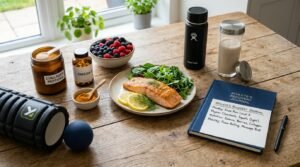
Collagen peptides (I use Vital Proteins or Great Lakes brand, 15 to 20 grams daily) have research backing their benefit for joint cartilage when taken consistently. I mix them into my morning coffee. Curcumin, the active compound in turmeric, has genuine anti-inflammatory properties, but you need a formulation with piperine (black pepper extract) for absorption. I take Thorne Meriva.
Omega-3 fish oil at 2 to 3 grams of combined EPA and DHA daily rounds out my joint support stack. Beyond supplements, eating enough protein (0.8 to 1 gram per pound of body weight) supports the muscle growth that protects your joints long-term. Staying at a healthy body weight also matters enormously. Every extra pound of body weight adds roughly four pounds of force on your knees during movement. That math adds up fast.
FAQs
Can I still build muscle with chronic knee pain?
Absolutely. Muscle growth requires progressive tension, not specific exercises. You can build impressive legs using hip thrusts, sled work, Romanian deadlifts, and modified leg presses without ever doing a traditional deep squat. Consistency and proper nutrition matter far more than any single exercise. I’ve added measurable quad and glute size while training around knee pain for three years.
What exercises should I completely avoid with bad knees?
There’s no universal “never do this” list because every knee condition differs. That said, most people with chronic knee pain should approach deep barbell back squats, jump squats, box jumps, and full-depth walking lunges with extreme caution. If an exercise causes sharp pain during or swelling after, remove it from your program regardless of how popular it is.
Are performance fitness plans for people who have chronic knee pain safe long-term?
When structured properly, they’re not just safe but beneficial. Strengthening the muscles around your knee reduces joint stress over time. The key is gradual progression, proper exercise selection, and consistent communication with your doctor or physical therapist. Doing nothing and letting your legs weaken is actually the riskier long-term choice for most knee conditions.
How often should I train legs if my knees hurt?
I train lower body twice per week with at least 72 hours between sessions. This gives my knees enough recovery time while still providing enough stimulus for strength and muscle gains. Some weeks, if inflammation is higher than usual, I drop to once and increase upper body volume instead. Listening to your body isn’t weakness. It’s strategy.
Should I wear a knee brace or sleeve while training?
Knee sleeves like Rehband 7mm neoprene sleeves provide warmth and mild compression, which many people with chronic knee pain find helpful during training. I wear mine on every lower body session. A proper medical brace is different and should only be used if prescribed. Sleeves won’t fix underlying problems, but they can make training more comfortable and give you a bit of confidence under load.
Conclusion
Training hard with chronic knee pain is absolutely possible, but it requires smarter planning than most generic fitness programs offer. The right combination of hip-dominant strength work, sled training, intelligent conditioning, and recovery strategies can keep you performing at a high level for years. What’s one exercise or strategy that’s helped your knees the most?