Performance fitness training for people who travel frequently for work sounds great on paper, but executing it from a different hotel room every week is a completely different challenge. I know because I spent three years flying out every Monday and coming home every Thursday, watching my strength and conditioning slowly slip away. The frustration of losing progress you worked hard for, while living out of a carry-on, is something most generic fitness advice completely ignores.
Why Traditional Programs Fail on the Road
Most fitness programs assume you have consistent access to the same gym, the same schedule, and the same kitchen. Road warriors have none of that. One week you’re at a Marriott with a decent fitness center. The next week you’re at a boutique hotel with two dumbbells and a broken treadmill.
I tried following a standard push/pull/legs split for months while traveling. It fell apart constantly. The program called for barbell squats on Tuesday, but my Tuesday gym had no squat rack. So I’d skip it, tell myself I’d make it up, and never did. The real problem wasn’t motivation. It was rigidity. A program built for a home gym simply cannot survive the chaos of weekly travel. You need a framework that bends without breaking, one designed around equipment uncertainty and time constraints from the start.
Build Your Training Around Movement Patterns, Not Equipment
This single shift changed everything for me. Instead of programming around specific equipment like barbells and cable machines, I started organizing my workouts around six fundamental movement patterns: squat, hinge, push, pull, carry, and core. Every workout hits three or four of these patterns, regardless of what equipment is available.
Here’s why this works so well for travelers. If the hotel gym has dumbbells, you do dumbbell Romanian deadlifts for your hinge. If you only have bands, you do banded good mornings. If you have nothing at all, you do single-leg deadlifts with bodyweight. The movement pattern stays the same. The tool changes. Your body still gets the stimulus it needs, and you never waste time standing around a gym trying to figure out a substitute exercise on the fly.
I keep a simple note on my phone with three or four exercise options per movement pattern, ranging from fully equipped gym to zero equipment. It takes the guesswork out completely.
Performance Fitness Training for People Who Travel: The Minimum Effective Dose
Here’s something that took me way too long to accept: you don’t need five or six training sessions per week to maintain and even build real performance while traveling. You need three solid sessions. That’s it.
I structure my week like this. Session one focuses on lower body strength, built around squats and hinges. Session two targets upper body strength with pushes and pulls. Session three is a full-body conditioning session, usually something fast and intense that I can finish in 25 minutes. If I get a bonus fourth session, great. But three is the baseline, and I protect those three sessions like they’re client meetings.
The key is intensity over volume. When you only have three shots per week, you can’t afford to coast through any of them. Every set matters. I use RPE-based training, rating my perceived exertion on a 1 to 10 scale, so I can auto-regulate based on how my body feels after a red-eye flight or a day of back-to-back meetings. Some weeks I push hard. Some weeks I pull back slightly. But I always show up for those three sessions.
Schedule Your Workouts Like Flights
You wouldn’t leave your flight booking to chance, hoping you’ll find a good fare the day before. Treat your training the same way. The night before each travel day, I block out my workout window on my calendar with the same priority level as any meeting.
Morning sessions work best for most business travelers, and I’m no exception. By 6:30 AM, most hotel gyms are empty. By 7:30 AM, your workout is done before your day even starts. Trying to train after a full day of work, dinners, and networking is a losing strategy. I did it for six months and averaged maybe one evening workout per week. Once I switched to mornings, my consistency jumped to about 90%.
One practical trick that helped me enormously: I lay out my workout clothes on top of my suitcase the night before. When the alarm goes off at 5:45 AM in an unfamiliar room, the last thing you want is to fumble around in the dark looking for your shorts. Remove every friction point you can.
Master Bodyweight Training as Your Backup System
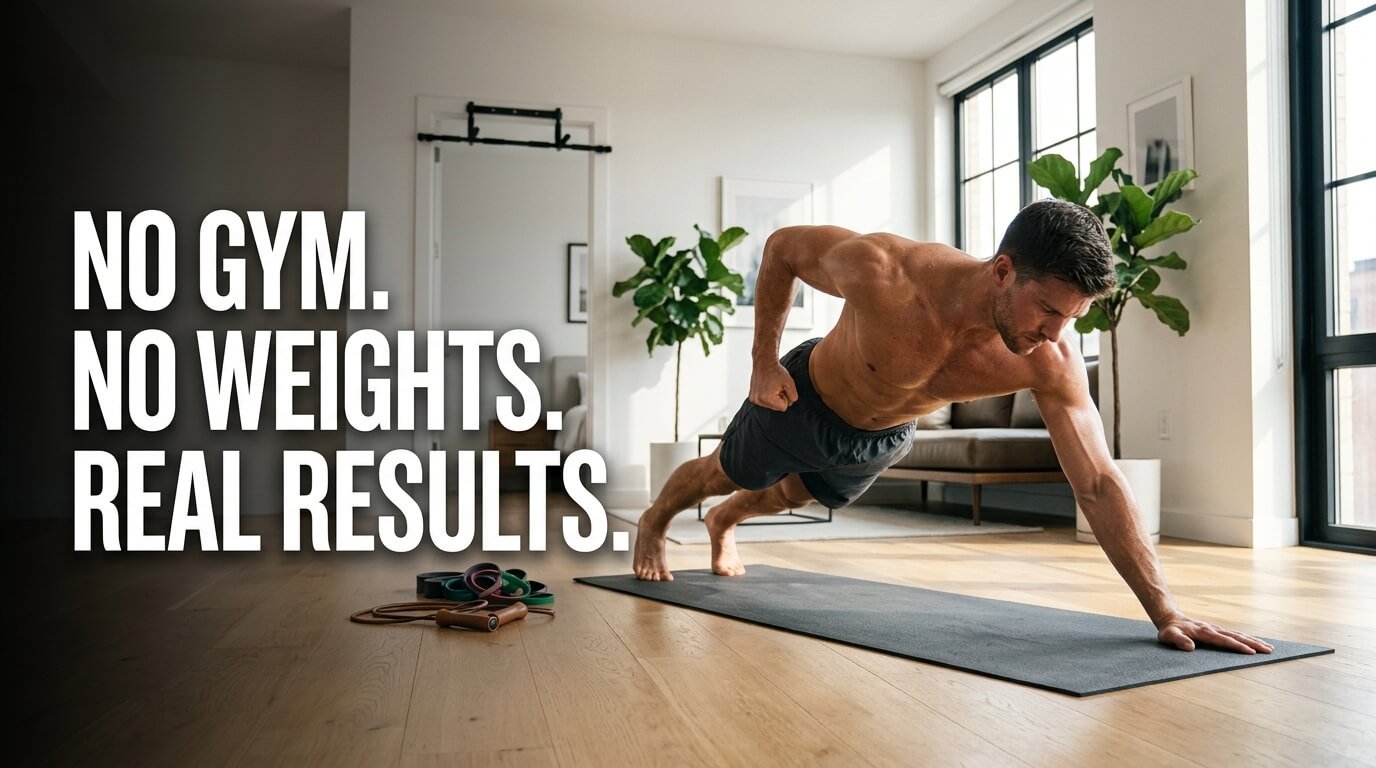
Bodyweight training isn’t just a fallback. For travelers, it’s a legitimate performance tool. I used to dismiss bodyweight work as too easy, until I actually tried doing a proper set of pistol squats or archer push-ups after weeks of only using dumbbells. Humbling, to say the least.
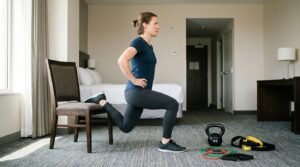
My go-to bodyweight workout when I have zero equipment takes about 30 minutes and absolutely wrecks me in the best way. It cycles through jump squats, push-up variations, single-leg hip thrusts, inverted rows using a desk or sturdy table, and plank variations. I run it as a circuit with minimal rest. The conditioning effect is brutal, and the strength stimulus is real if you pick challenging enough variations.
Investing time in learning progressions for bodyweight movements pays off massively on the road. If you can do pistol squats, Nordic curl negatives, handstand push-ups, and pull-up variations, you basically carry a full gym with you everywhere. Apps like FitBod and programs from GMB Fitness are solid resources for building these skills progressively.
Pack the Right Portable Gear
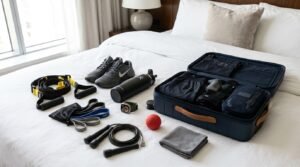
You don’t need much, but the right two or three items make a huge difference. After years of experimentation, here’s what lives permanently in my carry-on.
A set of looped resistance bands from brands like WODFitters or Perform Better weighs almost nothing and fits in any bag. I carry a light, medium, and heavy band. They handle warm-ups, accessory work, and can even provide real resistance for main movements like banded squats and presses.
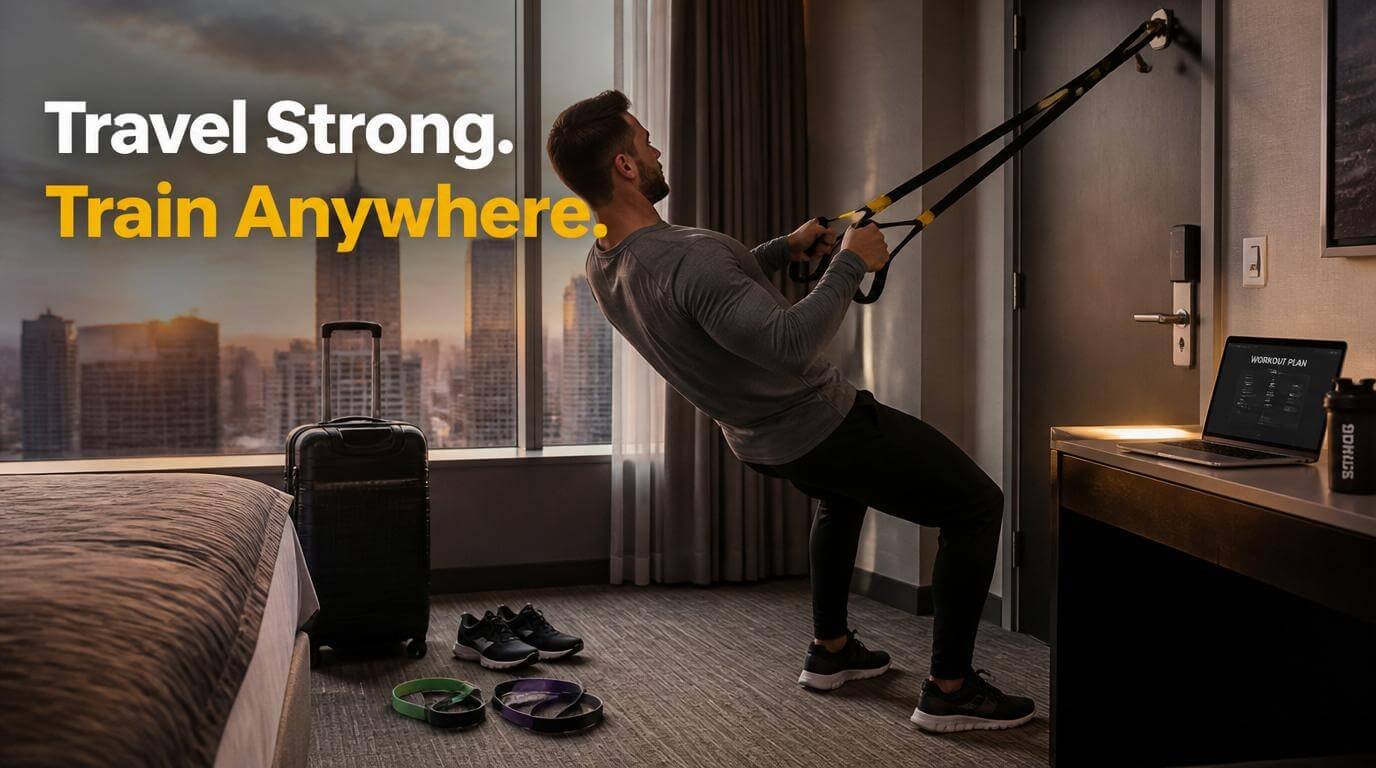
A TRX GO suspension trainer is the single best piece of travel fitness equipment I’ve ever bought. It hooks over any door and gives you rows, presses, hamstring curls, fallouts, and dozens of other exercises. It weighs about a pound. If I could only pack one thing, it would be this.
I also bring a lacrosse ball for soft tissue work. Sitting in planes and rental cars destroys your hips and thoracic spine. Five minutes of rolling before bed keeps me from feeling like a rusty hinge by Wednesday.
Nutrition on the Road Without Losing Your Mind
Training is only half the equation. Eating well while traveling for work is its own beast, especially when every meal involves restaurants, room service, or airport terminals.
I stopped trying to be perfect with nutrition on the road. Instead, I follow a few non-negotiable rules that keep me roughly on track without making me that person who brings Tupperware to a business dinner.
First, I prioritize protein at every meal. This is the one macronutrient that’s hardest to get enough of when eating out, and it’s the most important for maintaining muscle. Grilled chicken, salmon, eggs, Greek yogurt from the hotel breakfast, whatever is available. I aim for 30 to 40 grams per meal.
Second, I keep simple protein bars and packets of instant oatmeal in my bag for emergencies. RXBARs and Quaker instant oats have saved me from countless vending machine disasters at midnight.
Third, I stop stressing about everything else. If I hit my protein targets and eat mostly whole foods with vegetables at most meals, the rest takes care of itself. Trying to track every macro while navigating client dinners in different cities is a recipe for burnout, not fitness.
Recovery Is Where Travelers Fall Apart
Sleep deprivation, time zone changes, long flights in cramped seats, and the general stress of constant travel all crush recovery. And recovery is where your body actually adapts and gets stronger. Ignore it, and your training becomes counterproductive.
I learned this the hard way when I pushed through a particularly brutal travel month, training hard four times per week while averaging five hours of sleep and crossing three time zones. I got weaker, my joints ached, and I picked up a nagging shoulder injury that took months to fix.
Now I treat recovery with the same seriousness as my training sessions. I take magnesium glycinate before bed to improve sleep quality. I use a sleep mask and earplugs in every hotel, no exceptions. I do a 10-minute mobility routine from the GOWOD app most mornings, focusing on hips, thoracic spine, and ankles.
And here’s the unpopular truth: sometimes the best thing you can do for your performance fitness training is skip a workout and sleep an extra hour. If you slept four hours, crossed two time zones, and have a full day of presentations ahead, rest is the smarter play. Consistency over months beats intensity in any single week.

Track Progress Differently Than You Would at Home
When you train at home, tracking progress is straightforward. You add weight to the bar over time. On the road, with different equipment every week, you need a different approach.
I track three things. First, I log the movement pattern and the variation I used, so I can see that I’m consistently training all patterns across each week. Second, I note the RPE of my working sets, because if my RPE is trending downward over weeks for similar exercises, I know I’m getting stronger even without adding external load. Third, I do a simple monthly check-in with basic benchmarks: push-ups in 60 seconds, a bodyweight squat hold for time, and a plank hold. These travel with me anywhere and give me objective data.
Apps like Strong or Hevy make logging fast and easy, even between sets in a cramped hotel gym. The data keeps you honest and gives you proof that your on-the-road training is actually working.
FAQs
How many days per week should I train while traveling for work?
Three sessions per week is the sweet spot for most business travelers. It’s enough to maintain and build strength without wrecking your recovery in an already stressful schedule. If you can consistently hit three quality sessions each week you travel, you’ll stay ahead of most people who train five days at home but skip weeks whenever life gets busy.
Can I really build muscle with just bodyweight and resistance bands?
Absolutely, especially if you use challenging progressions. Single-leg squats, archer push-ups, band-resisted movements, and suspension trainer exercises can all provide enough stimulus for muscle growth. The key is progressive overload through harder variations, slower tempos, and added volume, not just doing endless reps of easy exercises.
What’s the best app for performance fitness training for people who travel frequently for work?
I’ve had the best results with the Strong app for tracking and FitBod for generating equipment-adaptive workouts. FitBod is particularly useful because you can tell it exactly what equipment you have available, and it builds a session around that. GOWOD is also excellent for daily mobility routines you can do in a hotel room.
How do I stay motivated when hotel gyms are terrible?
Reframe the expectation. You’re not there for the perfect training session. You’re there to check the box, maintain your patterns, and keep the habit alive. I’ve had some of my best workouts in the worst hotel gyms because limitations forced me to get creative. A single pair of 30-pound dumbbells and some floor space can deliver a seriously effective session.
Should I adjust my training when I change time zones?
Yes, and don’t overthink it. If you crossed more than two time zones, train at a lower intensity for the first session in the new zone. Your nervous system and hormones need a day to recalibrate. I usually make my first session in a new time zone a lighter mobility-focused workout, then go back to full intensity from the second session onward.
Conclusion
Staying fit on the road isn’t about willpower or finding the perfect gym. It’s about building a flexible system you can run from anywhere, with anything, and sticking to it week after week. The travelers who stay strong are the ones who lower the bar for showing up and raise it for effort once they’re there. What does your current travel training setup look like, and what’s the biggest thing holding you back?